GEOTECHNICAL ENGINEERING
FARGO

Geotechnical Engineering in Fargo

Practical geotechnics, field-tested.

LEARN MORE

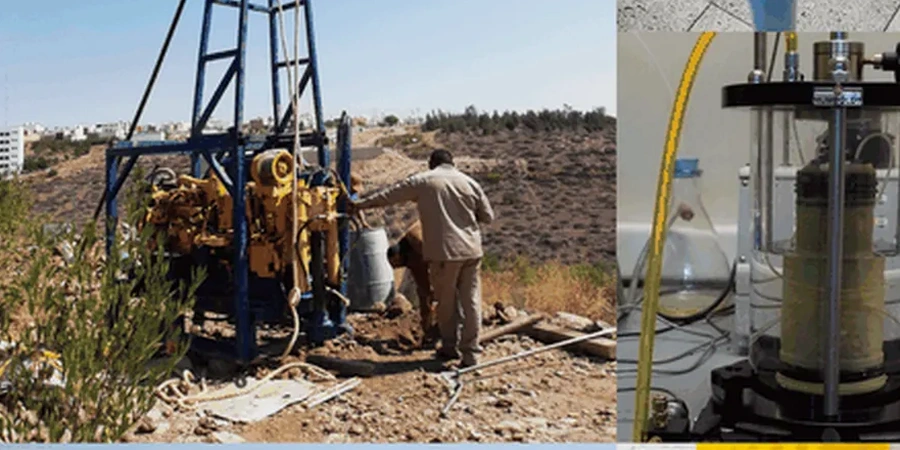
The Red River Valley doesn't forgive assumptions. Beneath Fargo's flat topography lie up to 30 meters of glaciolacustrine Lake Agassiz sediments—high-plasticity clays and silts with seasonal volume changes exceeding 15 cm. A soil mechanics study here has to quantify more than bearing capacity: it must resolve heave potential, consolidation settlement under long-term loading, and shear strength loss during the spring thaw. The city's frost depth reaches 1.8 m (72 inches), and the water table sits just 1.5 to 2.5 m below grade across much of Cass County. These conditions demand a program that integrates undisturbed Shelby tube sampling with laboratory triaxial testing and index property classification per ASTM D2487. Before layout decisions lock in, we typically recommend coupling the lab program with field CPT testing to map the continuous stratigraphy without sample disturbance, and Atterberg limits to bracket the plasticity range that governs shrink-swell behavior in Fargo's lean and fat clays.

Fargo's Lake Agassiz clays can lose 40% of their undrained shear strength during the spring thaw—lab consolidation and triaxial data are not optional here.
Geotechnical Engineering in Fargo
Technical reference — Fargo

Our service areas

Local geology

Glacial Lake Agassiz left a profile dominated by the Brenna and Sherack formations: stiff, overconsolidated clays in the upper 5 m, transitioning to normally consolidated clay below 10 m. Undrained shear strength in the crust often exceeds 100 kPa, but drops to 30–50 kPa in the underlying soft zone—a contrast that catches flatwork and lightly loaded footings off guard. Our soil mechanics study in Fargo follows ASTM D4767 for consolidated-undrained triaxial compression and ASTM D2435 for one-dimensional consolidation, delivering effective stress parameters and the compression index Cc needed for settlement calculations. Grain-size distribution via ASTM D6913 and hydrometer analysis completes the classification, while standard Proctor compaction per ASTM D698 establishes maximum dry density for engineered fill beneath slabs. When the site straddles the transition between Fargo's coarse-grained beach ridges and the fine-grained basin center, we add a sand cone density test during construction to verify compaction in the variable upper lifts. For deep foundation options in the soft lower clay, pile design relies directly on the undrained strength profile and consolidation parameters generated by the laboratory program.

Relevant standards

ASTM D4767 – Consolidated-Undrained Triaxial Compression Test on Cohesive Soils, ASTM D2435 – One-Dimensional Consolidation Properties of Soils, ASTM D2487 – Unified Soil Classification System, ASTM D4546 – One-Dimensional Swell or Collapse of Soils, IBC Chapter 18 – Soils and Foundations (2021 edition)

Need a geotechnical assessment?

Reply within 24h.

Email: contact@geotechnicalengineering1.org

Explanatory video

Why choose us

In Fargo, we often see distress in structures that skipped consolidation testing on the normally consolidated clay below 10 m. Total settlement under a 150 kPa footing load can reach 50–75 mm over 10 years, but differential settlement between the stiff crust and the soft zone is what cracks slab-on-grade floors and severs utility connections. Expansive behavior is another variable—clay fractions above 60% and plasticity indices over 30 produce seasonal heave that lifts unloaded slabs by 3–5 cm between January and April. A soil mechanics study in Fargo that omits swell-consolidation testing per ASTM D4546 leaves the structural engineer without the heave pressure needed to design stiffened slabs or void forms. The IBC Chapter 18 requires mitigating expansive soil risk when the plasticity index exceeds 15 and the water table fluctuates within the active zone—conditions met on nearly every commercial lot in Cass County.

Technical data

ParameterTypical value
Predominant soil unitLake Agassiz glaciolacustrine clay (CL, CH)
Undrained shear strength (Su) - crust80–120 kPa
Undrained shear strength (Su) - soft zone (>10 m)30–55 kPa
Overconsolidation ratio (OCR) - upper 5 m2.5–4.0
Compression index (Cc)0.25–0.45
Water table depth1.5–2.5 m below grade
Design frost penetration depth1.8 m (IBC Table 1809.5)
Standard Proctor maximum dry density1.60–1.78 Mg/m³

Frequently asked questions

What is the typical cost range for a soil mechanics study on a commercial lot in Fargo?
Which consolidation parameters matter most for slab-on-grade foundations in Fargo?

The compression index Cc and the swell index Cs from ASTM D4546 are the two critical numbers. They feed the heave and settlement calculations required by IBC Section 1808.6 when the plasticity index exceeds 15 and the active zone extends into the Lake Agassiz clays.

How deep do you sample for a soil mechanics study in the Red River Valley?

Boreholes typically reach 15 to 20 m to capture the transition from the overconsolidated crust into the normally consolidated soft clay. We sample continuously in the upper 5 m with Shelby tubes and at 1.5 m intervals below that, extending at least 3 m past the estimated zone of stress influence from the proposed foundation.

Location and service area

We serve projects across Fargo and surrounding areas.

View larger map