GEOTECHNICAL ENGINEERING
FARGO
HomeLaboratoryAtterberg limits

Atterberg Limits Testing in Fargo: Clay Behavior & Foundation Risk

Practical geotechnics, field-tested.

LEARN MORE

A commercial warehouse expansion near 45th Street hit a problem the geotechnical report didn't flag. The excavation exposed a lens of fat clay that turned plastic with the first spring thaw. Crews couldn't compact it. Water pooled. The schedule slipped three weeks. That clay lens was precisely the kind of material Atterberg limits testing is designed to quantify. In Fargo, where the Red River Valley deposits layers of lacustrine silts and high-plasticity clays over glacial till, the liquid limit and plastic limit aren't academic numbers. They define how a soil will behave when moisture changes—and moisture always changes here. A standard boring logs the stratigraphy, but only grain-size and Atterberg limits together classify the soil with enough precision to predict shrink-swell potential and frost heave susceptibility. For any project east of I-29, where the Sherack Formation clays dominate, skipping this test is a gamble on the foundation performance.

In Fargo's Red River Valley clays, a plasticity index above 25 is the threshold where foundation design changes from standard to conservative—every point matters.
Our service areas

How we work

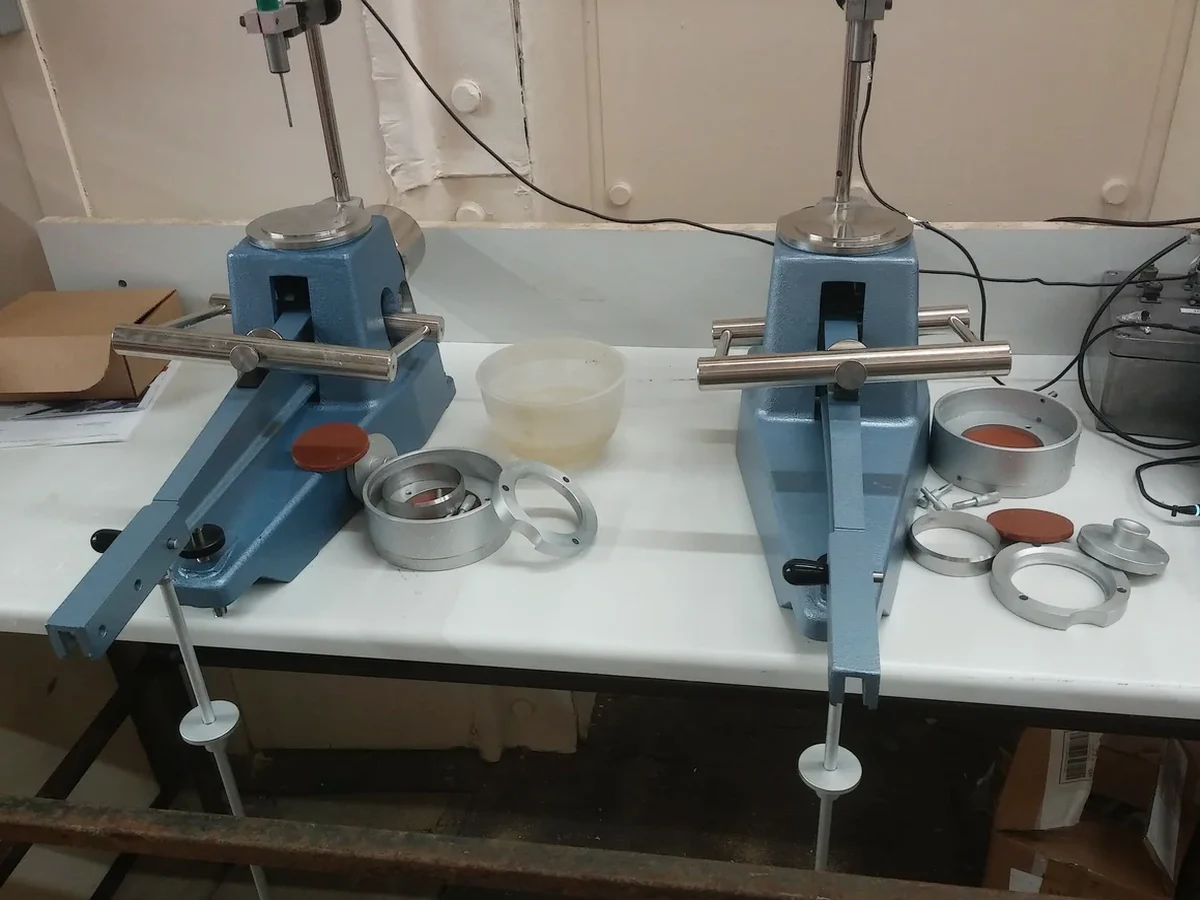
ASTM D4318-17 governs the laboratory determination of liquid limit, plastic limit, and the plasticity index. In Fargo's geotechnical practice, these values feed directly into USCS classification per ASTM D2487, which the IBC 2021 edition references for foundation bearing capacity adjustments. The liquid limit test uses the Casagrande cup device—a brass cup dropped 10 mm at two blows per second onto a hard rubber base. The technician counts the blows required to close a standard groove cut in the soil paste. The plastic limit is simpler but no less critical: the moisture content at which a 3.2 mm diameter thread of soil crumbles. The difference between the two numbers—the plasticity index—tells the design engineer how much volume change to expect during wet-dry cycles. Fargo's lean clays (CL) typically show liquid limits between 30 and 45, but the fat clays (CH) in the Red River backswamp deposits can exceed 60. When the plasticity index crosses 25, the foundation design shifts. We often pair Atterberg testing with proctor-tests to determine whether on-site clay can be moisture-conditioned and recompacted, or whether it needs to be undercut and replaced with granular fill from the Sheyenne Delta borrow sources west of town.
Atterberg Limits Testing in Fargo: Clay Behavior & Foundation Risk
Technical reference — Fargo

Local ground factors

The Casagrande cup sits on a vibration-free bench in the lab, a technician working the crank by hand—two revolutions per second, steady rhythm, counting each blow until the groove closes over half an inch. It's a manual test that demands consistency. Samples arrive from Fargo drill rigs in sealed glass jars to preserve the in-situ moisture. The lab runs the multi-point liquid limit method, plotting water content against blow count on semi-log paper, then reading the value at 25 blows. The plastic limit thread-rolling takes practice: too much pressure and you underestimate the limit, too little and you miss the crumbling point. For Fargo projects, the biggest risk isn't the test precision—it's using results from a single boring and assuming the entire site is uniform. The Red River's meander history means a lean clay at one end of the parcel can transition to fat clay within 100 feet. Variability in the plasticity index across a site is the primary reason foundations get over-designed or, worse, under-designed. The lab report flags outliers immediately.

Need a geotechnical assessment?

Reply within 24h.

Email: contact@geotechnicalengineering1.org

Explanatory video

Relevant standards

ASTM D4318-17 (Standard Test Methods for Liquid Limit, Plastic Limit, and Plasticity Index of Soils), ASTM D2487-17 (Standard Practice for Classification of Soils for Engineering Purposes — Unified Soil Classification System), IBC 2021 Section 1803 (Geotechnical Investigations — referencing USCS classification)

Technical data

ParameterTypical value
Standard Test MethodASTM D4318-17
Liquid Limit DeviceCasagrande cup (brass, 10 mm drop)
Plastic Limit Thread Diameter3.2 mm (1/8 in)
Sample PreparationWet preparation, sieved through No. 40 (425 µm)
Reporting UnitsMoisture content (%), dimensionless PI
Typical Fargo CL Liquid Limit Range30–45
Typical Fargo CH Liquid Limit Range50–75+
Plasticity Index Threshold for High Shrink-SwellPI > 25 (per FHWA NHI-132040)

Frequently asked questions

What do Atterberg limits actually tell a foundation engineer about Fargo soils?

The liquid limit indicates the water content where the soil transitions from plastic to liquid behavior. The plastic limit marks the boundary between semi-solid and plastic states. The difference—the plasticity index—correlates directly with the soil's capacity to absorb water and swell. In Fargo's Red River Valley clays, a PI above 25 signals significant shrink-swell potential, meaning the foundation depth may need to extend below the active moisture zone, typically 6 to 8 feet here. The values also determine the USCS classification, which the IBC uses to assign presumptive bearing capacities.

How much does Atterberg limits testing cost for a residential lot in Fargo?
How long does the test take from sample delivery to report?

The laboratory procedure itself takes one to two days, including overnight oven-drying for the moisture content determinations. Standard reporting turnaround is three business days from sample receipt. Rush processing can deliver results in 24 hours if scheduled in advance, which is common during Fargo's short construction season when excavation and footing placement need to happen quickly.

Can Atterberg limits predict frost heave susceptibility in Fargo?

Yes, indirectly. Soils with high plasticity index values, particularly silty clays and fat clays, tend to have high capillary rise potential. Combined with Fargo's cold winters and typical frost penetration depth of 60 to 72 inches, these soils are Class F4 (highly susceptible) per the USACE frost design methodology. The Atterberg limits data, paired with grain-size distribution, allows the engineer to classify the frost susceptibility and recommend foundation depths below the frost line or subgrade insulation strategies.

Location and service area

We serve projects across Fargo and surrounding areas.

View larger map