GEOTECHNICAL ENGINEERING
FARGO
HomeSeismicBase isolation seismic design

Base Isolation Seismic Design for Fargo Structures

Practical geotechnics, field-tested.

LEARN MORE

A three-story mixed-use building near Broadway was the first project in Fargo where we saw the design team push full base isolation. The site sat on 40 feet of lacustrine clay, and the spectral acceleration from a 2,500-year event would have pushed a fixed-base frame past drift limits. We ran nonlinear time-history analyses with isolator properties tuned to the site-specific response spectrum. The isolation period shifted the structure well past the peak demand. That project taught us how much the Red River Valley soils amplify long-period motion, and we have carried that lesson into every isolation scheme since. When the soil profile includes thick, soft clay over glacial till, the ground motion at the surface looks nothing like the rock outcrop hazard. A seismic microzonation study helps define the basin edge effects that isolation bearings must accommodate.

The Red River Valley clays amplify long-period motion, so an isolation period of 3 to 4 seconds often yields the best drift reduction.
Our service areas

How we work

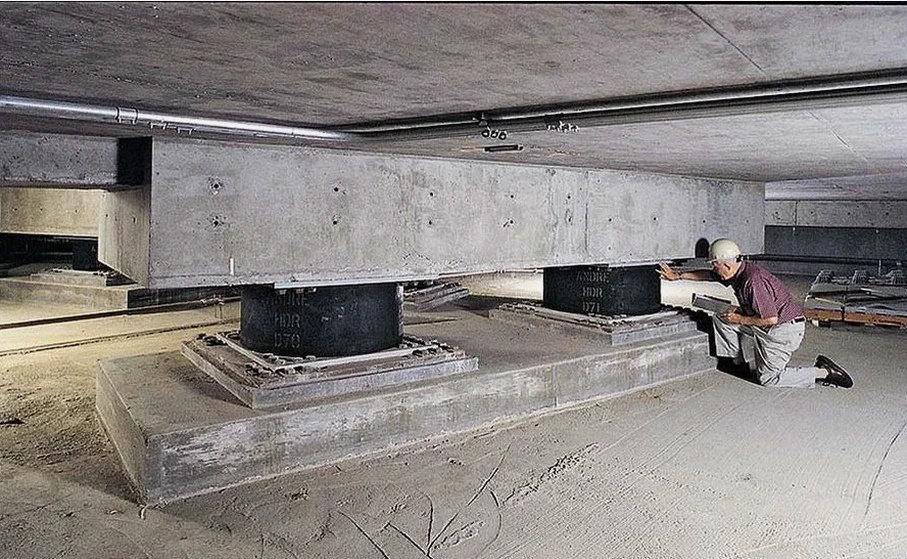
Fargo sits in a low-to-moderate seismic hazard zone by national maps, but the deep soft soil changes the equation. ASCE 7-22 site class E or F profiles are common here. That means short-period acceleration gets damped, while long-period content amplifies. An isolation system that targets a period of 3 to 4 seconds benefits from this shift, but it also demands careful displacement checks. We design lead-rubber and high-damping rubber bearing layouts with a supplemental moat wall clearance that accounts for the maximum considered earthquake displacement plus accidental torsion. The freeze-thaw cycle adds another challenge: the isolation plane must remain functional after the foundation concrete sees 100-degree temperature swings each year. Our team specifies low-temperature elastomer compounds tested per AASHTO M251 procedures. One thing we always stress is that the superstructure still needs ductile detailing. Isolation reduces force demand, but it does not eliminate it.
Base Isolation Seismic Design for Fargo Structures
Technical reference — Fargo

Local ground factors

The upper 30 to 50 feet of Fargo soil is Lake Agassiz sediment: lean clay with high plasticity and undrained shear strength under 800 psf near the surface. When a 500-year event hits, that clay can experience modulus degradation that lengthens the site period further. An isolation design that does not account for this shift may end up closer to resonance than intended. We have also seen projects where the moat wall was sized for DBE displacement, not MCE. That is a code violation under ASCE 7-22 Section 17.5.4.2, and it risks bearing impact during extreme motion. The other local risk is frost heave. If the isolation plane is below grade and drainage is poor, ice lens growth under the lower mat can lock the bearings. We detail perimeter drains with positive slope to daylight and specify non-frost-susceptible backfill below the isolation level.

Need a geotechnical assessment?

Reply within 24h.

Email: contact@geotechnicalengineering1.org

Explanatory video

Relevant standards

ASCE 7-22 Minimum Design Loads and Associated Criteria for Buildings and Other Structures, IBC 2021 Chapter 17 Special Inspections and Tests, AASHTO M251 Standard Specification for Elastomeric Bridge Bearings, NEHRP Recommended Seismic Provisions for New Buildings, FEMA P-751 NEHRP Provisions Commentary

Technical data

ParameterTypical value
Design ground motionASCE 7-22 Chapter 11 & 17, site-specific response spectrum
Isolator types evaluatedLead-rubber bearings (LRB), high-damping rubber bearings (HDRB), friction pendulum (FPS)
Target isolation period2.5 to 4.0 seconds, depending on soil profile and spectral shape
MCE displacement capacityCalculated per ASCE 7 Section 17.5, including torsional amplification
Low-temperature elastomerCompounds rated to -30°F per AASHTO M251 low-temperature test
Prototype testingFull-scale bearing tests per ASCE 7-22 Section 17.8 for property verification

Frequently asked questions

Does Fargo even need base isolation? The seismic hazard looks low on the maps.

The mapped short-period hazard is moderate, but the deep soft clay profile amplifies long-period motion significantly. Many Fargo buildings on site class E or F see spectral accelerations at 1-second period that are two to three times the rock value. For essential facilities or taller structures where drift control is critical, isolation is often the most cost-effective way to meet ASCE 7 performance objectives.

What isolator types work best with Fargo's soil profile?

In our experience, lead-rubber bearings and high-damping rubber bearings both perform well. The key is tuning the post-elastic stiffness to achieve a 3-to-4-second isolated period. Friction pendulum systems also work, but the flat-slider radius must be checked against the large MCE displacements the soft soil demands. We usually run a trade study comparing at least two isolator types before final selection.

How do you handle the freeze-thaw risk below the isolation plane?

We specify low-temperature elastomer compounds tested per AASHTO M251 to -30°F. Below-grade isolation pits get perimeter drains with 1% slope to daylight and non-frost-susceptible granular backfill. We also require a thermal break between the lower mat and the isolation bearing to prevent frost penetration through the concrete mass.

What is the typical cost range for base isolation design on a mid-rise building in Fargo?

Location and service area

We serve projects across Fargo and surrounding areas.

View larger map