GEOTECHNICAL ENGINEERING
FARGO
HomeSeismicSeismic microzonation

Seismic Microzonation in Fargo: Ground Response Beyond the Uniform Code

Practical geotechnics, field-tested.

LEARN MORE

Fargo’s modern skyline obscures a past when the Red River’s meandering course defined every foundation decision. The city grew outward from a frontier river post into a regional medical and education hub, yet the subsurface never received a structural upgrade: beneath the streets lie 100 to 200 feet of plastic, high-moisture Lake Agassiz clays that behave poorly under cyclic loading. When the 2018 West Fargo expansion pushed mid-rise buildings into the deep clay basin, conventional site-class assumptions started to show their limits. We use seismic microzonation to replace generic Site Class D or E defaults with measured Vs profiles and site-specific amplification functions, giving structural engineers a defensible basis for base shear adjustment. This work ties directly to ASCE 7-22 Chapter 20 and the IBC 2021 seismic provisions, and in Fargo it almost always reveals softer conditions than the code’s default tables predict. Understanding that mismatch early prevents both over-conservative steel tonnage and under-designed lateral systems.

In Fargo, Site Class determined by proxy routinely underestimates amplification: measured Vs30 values below 180 m/s are more common than the county-wide maps suggest.
Our service areas

How we work

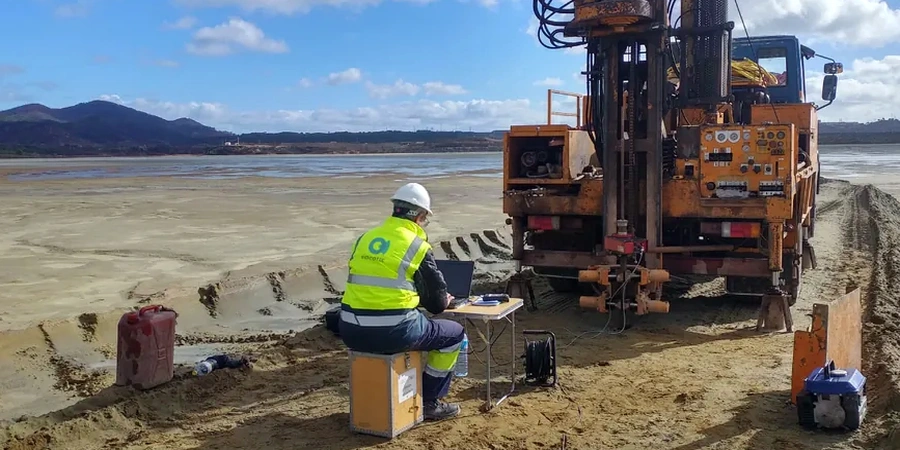
A seven-story medical office building near the Sanford Medical Center campus illustrated the typical Fargo problem in sharp relief. The preliminary geotech report assigned Site Class D based on blow counts from SPT drilling in the upper 30 meters, but the owner’s risk consultant flagged the absence of a measured shear-wave velocity profile. Our crew mobilized a 24-channel geophone spread and collected surface-wave data across the building footprint plus two offset arrays. Inversion of the dispersion curve produced a Vs30 of 192 m/s, firmly in Site Class E territory, and the site period stretched to 0.82 seconds. That single measurement changed the seismic base shear by 18% and triggered a deeper foundation review. In parallel we sampled the upper clay crust for Atterberg limits to correlate plasticity with the low-strain shear modulus; the PI values exceeded 35 across the upper 15 meters, consistent with the soft response seen in the Vs profile. These two datasets, velocity and plasticity, provide a defensible ground-motion input for the structural engineer without resorting to the 30-meter average alone.
Seismic Microzonation in Fargo: Ground Response Beyond the Uniform Code
Technical reference — Fargo

Local ground factors

ASCE 7-22 allows Site Class determination by Vs30 measurement or by proxy when soils are known, but the proxy path in Fargo frequently underestimates amplification because the deep lacustrine profile lacks the impedance contrast that the default tables assume. We have measured Vs30 values below 180 m/s in neighborhoods mapped as Class D by county-wide surficial geology alone. The operational consequence is a base shear demand 15 to 25 percent higher than the design team anticipated, discovered during peer review rather than during 65% CD submissions. A liquefaction screening is often layered into the same campaign because loose alluvial silts lenses appear within the clay sequence at depths between 15 and 35 feet. When the site amplification factor exceeds 2.0 at the structural period of interest, we also recommend checking the seismic isolation feasibility early, particularly for essential facilities that must remain operational after a 475-year event. The cost of a microzonation study in Fargo is minor compared to redesigning the lateral system after the geotechnical baseline report has already been signed off.

Need a geotechnical assessment?

Reply within 24h.

Email: contact@geotechnicalengineering1.org

Relevant standards

ASCE 7-22 Chapter 20 – Site Classification Procedure, IBC 2021 Section 1613 – Earthquake Loads, ASTM D4428/D4428M-17 – Crosshole Seismic Testing, USGS National Seismic Hazard Model 2023, NEHRP Recommended Provisions, 2020 Edition

Technical data

ParameterTypical value
Vs30 measured range (Fargo deep clay basin)150–230 m/s (Site Class E to D boundary)
Predominant site period (T₀)0.6–1.1 s
Surface-wave methodMASW / MAM, 24–48 channel, 4.5 Hz geophones
Target depth of investigation30–60 m below grade
Reference ground motionUSGS NSHM 2023, 2% in 50-year hazard
Amplification factor range (short period)1.4–2.3 for 0.2 s spectral acceleration
Reporting standardASCE 7-22 §20.3, IBC 2021 §1613

Frequently asked questions

Does Fargo even need seismic microzonation, given the low regional seismicity?

Seismic hazard in Fargo is moderate, not negligible. The USGS NSHM assigns a 2%-in-50-year PGA around 0.04–0.06g on rock. However, the deep, soft Lake Agassiz clays amplify that motion significantly. A measured Vs30 below 200 m/s can push the site into Class E, increasing design spectral accelerations by 30–50% relative to a default Class D assumption. For essential facilities, schools, and mid-rise buildings, that difference drives lateral system design and cost. Microzonation replaces assumptions with measured ground response.

What is the typical cost range for a site-specific seismic microzonation study in Fargo?
How long does a microzonation field campaign take on a typical Fargo site?

A MASW survey across a standard commercial lot in Fargo takes one to two field days, depending on array length and access constraints. Data processing, inversion, and the 1D site-response report typically require an additional 10 to 15 business days. If 2D modeling is needed because the site is near the river terrace, add another week for mesh generation and simulation runtime.

Can microzonation reduce the seismic design category for my project?

In some cases, yes. The IBC allows site-specific ground motion procedures under Section 1613.1. If measured Vs30 and site response analysis demonstrate that amplification is lower than the code-default for the mapped Site Class, the design spectral accelerations can be reduced. In Fargo, however, the more common outcome is the opposite: measured conditions are softer than assumed, and the microzonation justifies a higher, but accurate, design demand rather than a reduction.

What is the difference between a standard Vs30 measurement and a full microzonation study?

A standard Vs30 measurement, typically by MASW, delivers a single shear-wave velocity profile and a Site Class letter per ASCE 7 Table 20.3-1. A full microzonation study goes further: it uses that Vs profile together with modulus-reduction and damping curves to perform 1D or 2D ground-response analysis, producing site-specific surface response spectra and acceleration time histories. The full study quantifies how much the ground amplifies motion at the structural periods of interest, not just which Class it falls into.

Location and service area

We serve projects across Fargo and surrounding areas.

View larger map