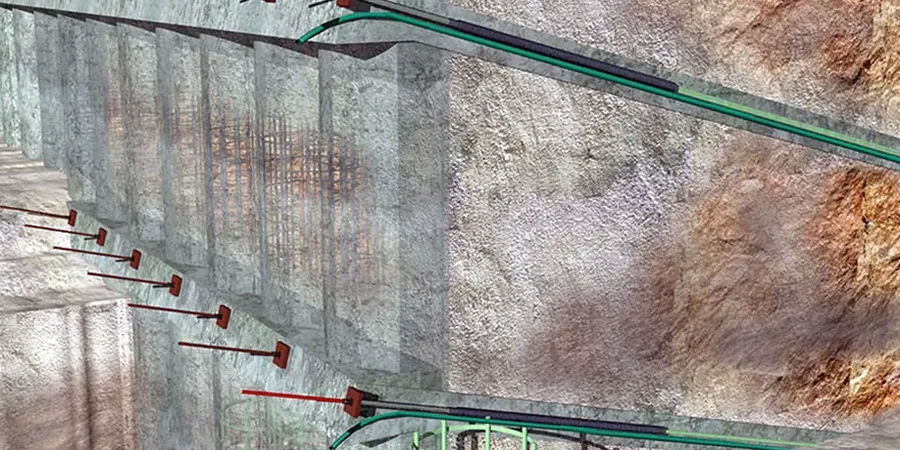
A recent commercial excavation near downtown Fargo—just blocks from the Red River—required a 28-foot shoring system through interbedded glaciolacustrine silts and clays before hitting a dense till layer at depth. The general contractor had assumed tiebacks would be straightforward, but the saturated overburden produced undrained shear strengths below 800 psf in the upper 15 feet, forcing a complete redesign of the anchor bond zone lengths. Our design team analyzed the in-situ vane shear profiles and ran finite-difference load-transfer simulations to determine that single-corrosion-protection strand anchors with pressure-grouted bond lengths of 18 to 22 feet could mobilize the necessary capacity without exceeding allowable ground deformations. In Fargo’s Lake Agassiz plain deposits, where stratigraphy can shift from fat clay to silty sand within 100 feet laterally, anchor selection is never a copy-paste exercise from a previous job. We routinely pair anchor design with a liquefaction assessment when the project lies within the mapped moderate-seismicity zone of eastern North Dakota, ensuring the anchorage system remains serviceable under the design earthquake scenario defined by the IBC and ASCE 7-22.
In Fargo’s Lake Agassiz clays, anchor bond stress rarely exceeds 12 psi without pressure grouting, making post-grouting verification essential for any permanent anchorage.