GEOTECHNICAL ENGINEERING
FARGO
HomeUnderground ExcavationsGeotechnical analysis for soft soil tunnels

Soft Ground Tunnel Analysis in Fargo: Geotechnical Reality Under the Red River Valley

Practical geotechnics, field-tested.

LEARN MORE

The most expensive mistake in Fargo tunnel projects happens before ground is broken. Contractors treat the Lake Agassiz clay like ordinary stiff soil. It isn't. This glaciolacustrine deposit spans the entire Red River Valley, with undrained shear strengths that can drop below 25 kPa in the fat clay layers. Pore pressure dissipation takes weeks. Tunnel face instability develops without warning in these conditions. We run site-specific triaxial and consolidation tests to define the exact stress path your TBM or sequential excavation method will face. Pairing this with an in-situ permeability program gives the true hydraulic conductivity, not the textbook value that gets projects in trouble.

Lake Agassiz clay doesn't fail with warning. It deforms plastically, redistributes pore pressure, and collapses when the undrained shear strength threshold is crossed.
Our service areas

Methodology and scope

Fargo sits at 276 meters elevation on a lake plain with less than 0.5% regional slope. That flat topography hides a complex stratigraphy. The Brenna and Sherack formations alternate between plastic silt and lean clay, with occasional sand lenses that act as confined aquifers. Tunneling between 6 and 20 meters depth almost always intersects the transition zone where oxidized brown clay gives way to grey, fully saturated material. Standard penetration resistance here can read N60 values of 2 to 4 over several meters. We classify every sample per ASTM D2487, run Atterberg limits to confirm plasticity, and measure consolidation parameters that govern long-term settlement above the tunnel crown. The lab data feeds directly into the numerical model—no generic assumptions.
Soft Ground Tunnel Analysis in Fargo: Geotechnical Reality Under the Red River Valley
Technical reference — Fargo

Local considerations

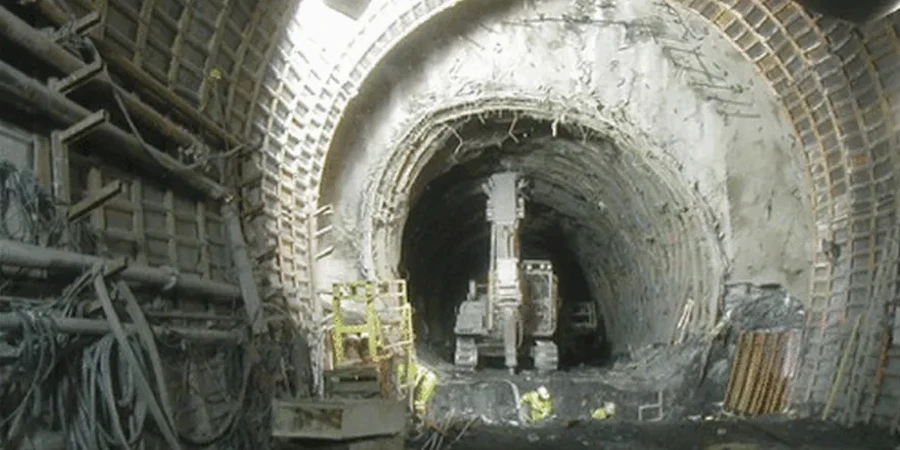
Fargo’s underground infrastructure grew slowly until the flood diversion project pushed serious tunneling onto the table. Before that, deep excavation was rare. The city’s sanitary and storm networks stayed shallow, above the worst of the soft clay. Now, with the diversion channel inlet structures and associated conveyance tunnels, the geotechnical community faces cuts through material that was never meant to hold an opening. The biggest hazards are face extrusion in open-face TBMs, crown settlement under shallow cover near Cass County roads, and rapid remolding if groundwater breaches a sand lens. Our analysis quantifies stand-up time and required face pressure before mobilization. In zones with sensitivity above 4, we recommend pre-treatment options verified through field trials.

Need a geotechnical assessment?

Reply within 24h.

Email: contact@geotechnicalengineering1.org

Applicable standards

ASTM D2487-17 (USCS classification), ASTM D4767-11 (CU triaxial on cohesive soils), ASTM D2435-20 (one-dimensional consolidation), ITIG TBM Tunneling in Soft Ground Guidelines, ASCE 7-22 (seismic design for buried structures)

Technical parameters

ParameterTypical value
Undrained shear strength (Su)12–50 kPa (fat clay to lean silt)
Liquidity Index0.8–1.4 (soft to very soft consistency)
Coefficient of consolidation (Cv)0.5–3.0 m²/year
Natural water content35–65%
Sensitivity (St)2–8 (remolded strength loss)
Overconsolidation Ratio (OCR)1.0–2.5 (upper crust)

Frequently asked questions

What makes Fargo clay so difficult for tunneling?

The Lake Agassiz deposits have high plasticity, natural water content near the liquid limit, and low hydraulic conductivity. This combination means pore pressures generated during excavation dissipate slowly, keeping effective stress low at the face. Sensitivity values can exceed 4, so any disturbance—vibration, remolding, water influx—triggers a rapid strength loss.

Which lab tests are mandatory before designing a soft ground tunnel here?

At minimum, we run Atterberg limits, one-dimensional consolidation, and consolidated-undrained triaxial tests with pore pressure measurement. If sand lenses are present, we add constant-head permeability tests. The consolidation data is critical—Fargo clays often show Cv values below 1 m²/year, which controls both construction rate and post-construction settlement.

How much does a tunnel geotechnical investigation cost in Fargo?

The investigation budget typically falls between US$3,640 and US$18,890, depending on borehole depth, number of samples, and the laboratory test schedule. A shallow investigation with limited triaxial testing sits at the lower end. Deep boreholes with full consolidation suites, piezometer installation, and constitutive modeling push toward the upper range.

Can you model TBM face pressure requirements from lab data?

Yes. We derive the undrained shear strength profile from triaxial tests, compute the stability number for the tunnel geometry, and output the minimum face pressure to prevent extrusion. For drained conditions in sand lenses, we calculate the required pressure to maintain a stable filter cake.

Location and service area

We serve projects across Fargo and surrounding areas.

View larger map