GEOTECHNICAL ENGINEERING
FARGO
HomeInvestigationCPT (Cone Penetration Test)

Cone Penetration Test (CPT) in Fargo — Continuous Soil Profiling

Practical geotechnics, field-tested.

LEARN MORE

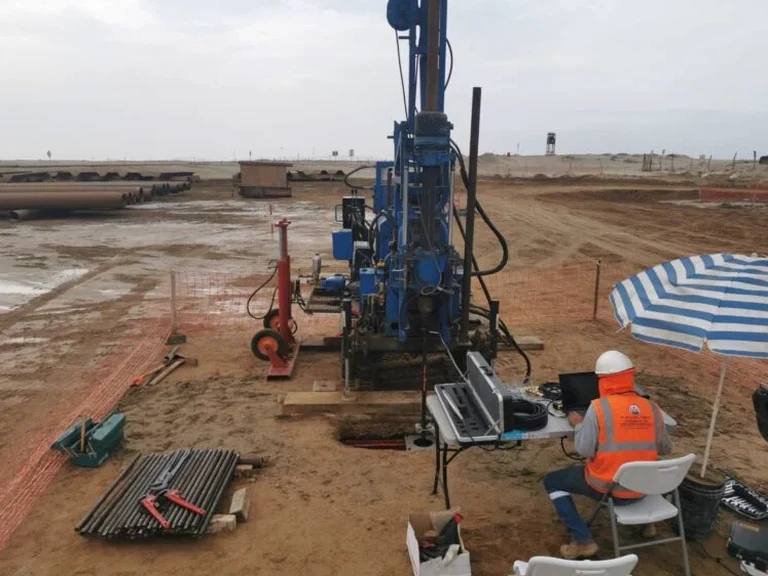
ASTM D5778 governs every cone penetration test we run in Fargo, and for good reason. The Red River Valley’s lacustrine clays and interbedded silts demand continuous stratigraphic resolution that conventional borings simply cannot deliver. Our 20-ton CPT rig collects tip resistance, sleeve friction, and dynamic pore pressure at 2 cm intervals, building a near-continuous log of soil behavior type without the disturbance inherent in sampling. In a city where seasonal groundwater fluctuates between 3 and 8 feet below grade, the pore pressure dissipation tests we run during CPT soundings provide direct estimates of consolidation characteristics that govern settlement calculations. For projects near the Sheyenne River diversion or downtown infill sites where soft, normally consolidated clays extend past 60 feet, the cone penetration test eliminates the blind spots that can derail a foundation design. Combining CPT data with grain size laboratory work and Atterberg limits from thin-walled tube samples gives us a complete picture of the soil profile.

Continuous CPT profiles in Fargo reveal thin desiccated crust layers that SPT borings routinely miss — and those layers change bearing capacity by 30 percent.
Our service areas

Methodology and scope

A recent warehouse project off 45th Street illustrated exactly why CPT dominates site investigation in Fargo. The geotechnical brief called for bearing capacity verification across a 4-acre footprint underlain by 30 feet of compressible Lake Agassiz sediments. We deployed a 20-ton CPT rig with seismic cones at 25 locations over two days, measuring shear wave velocity every meter to establish site class per IBC Chapter 20. The continuous tip resistance profiles revealed a thin, desiccated crust over normally consolidated lean clay — a stratigraphic detail that standard SPT borings at 5-foot intervals had completely missed on a neighboring parcel. Cone penetration test data from Fargo sites consistently show this crustal layer varying between 3 and 6 feet thick, and its presence changes shallow footing bearing capacity by 30 percent or more. Our team uses dissipation tests at multiple depths to estimate the coefficient of consolidation directly, avoiding the week-long delays of oedometer testing when construction schedules are tight. The pore pressure ratio we calculate from u2 measurements flags underconsolidated zones that would otherwise go undetected until excavation revealed the problem.
Cone Penetration Test (CPT) in Fargo — Continuous Soil Profiling
Technical reference — Fargo

Local considerations

Fargo sits at an elevation of 906 feet above sea level in the flat lacustrine plain of glacial Lake Agassiz, and that geology creates a specific set of subsurface hazards. The normally consolidated to lightly overconsolidated clays that dominate the upper 40 to 80 feet are prone to sampling disturbance when conventional split-spoon methods are used; a disturbed sample yields undrained shear strengths that can be 50 percent lower than in-situ values. CPT eliminates that disturbance entirely. Soft clay layers interbedded with silt lenses produce pore pressure spikes during cone advancement, and failure to measure u2 at the cone shoulder means missing these drainage boundaries that control consolidation rate. In Fargo’s cold climate, seasonal freeze-thaw cycles affect the upper 5 to 8 feet of soil, altering tip resistance readings seasonally — we account for this by referencing long-term temperature data from the NDAWN network when interpreting shallow CPT data. Liquefaction assessment in the sandier units occasionally encountered at depth follows the Robertson-Wride method, with CPT-based cyclic resistance ratios providing more reliable estimates than SPT-based approaches in silty sands.

Need a geotechnical assessment?

Reply within 24h.

Email: contact@geotechnicalengineering1.org

Explanatory video

Applicable standards

ASTM D5778-20 — Standard Test Method for Electronic Friction Cone and Piezocone Penetration Testing of Soils, IBC Chapter 20 — Site Classification using shear wave velocity from seismic CPT, Robertson 2016 — CPT-based soil behavior type classification and liquefaction assessment

Technical parameters

ParameterTypical value
Cone Tip Resistance (qc)0.5 – 25 MPa (typical Fargo soft clay range)
Sleeve Friction (fs)5 – 150 kPa, friction ratio 1–8%
Dynamic Pore Pressure (u2)Measured at cone shoulder, u2 profiles
Soil Behavior Type (SBT)Robertson 2016 classification, normalized
Shear Wave Velocity (Vs)Seismic cone, 1-m intervals per IBC site class
Piezocone Dissipation Testst50-based ch estimation at 3–6 depths per sounding
Maximum Depth100 ft (standard), deeper with pre-drilling available

Frequently asked questions

What depth can a CPT rig reach in Fargo soils?

Our 20-ton CPT truck typically reaches 80 to 100 feet in the soft lacustrine clays common across the Fargo area. When stiffer till layers or dense sand lenses are encountered, refusal may occur earlier. For deeper targets, we can pre-drill through problematic layers and continue the CPT sounding below. The Red River Valley's normally consolidated clays generally allow excellent penetration with standard cone equipment.

How much does a CPT sounding cost in Fargo?

CPT soundings in the Fargo area typically range from US$160 to US$250 per sounding, depending on depth, whether seismic cones are required, and the number of dissipation tests specified. Mobilization is priced separately based on location within Cass County. A full-day program with 8 to 12 soundings provides the most cost-effective approach for larger sites.

How does CPT compare to SPT borings for Fargo's clay soils?

In Fargo's soft Lake Agassiz clays, CPT provides continuous stratigraphic profiles that SPT borings cannot match. Standard penetration testing samples every 5 feet and disturbs sensitive clay structure during driving, which reduces measured strength by as much as 50 percent. CPT measures in-situ tip resistance and pore pressure without disturbance, revealing thin sand seams, crust layers, and drainage boundaries that SPT logs routinely miss.

Do you need a separate drilling crew for CPT testing?

No separate drilling crew is required. Our CPT rig is a self-contained 20-ton truck with onboard hydraulic rams that push the cone into the ground at a constant 2 cm per second rate. No augers, no drilling fluid, no cuttings to manage. Setup takes 10 to 15 minutes per location, and a typical 60-foot sounding in Fargo's clays is completed in 45 minutes including dissipation tests.

What data do I get from a CPT in Fargo's soft clays?

Every CPT sounding delivers continuous profiles of cone tip resistance (qc), sleeve friction (fs), friction ratio, and dynamic pore pressure (u2). From these we derive normalized soil behavior type per Robertson 2016, undrained shear strength using an Nkt factor calibrated to regional experience, preconsolidation stress estimates, and consolidation coefficients from dissipation test data. Seismic CPT adds shear wave velocity profiles for IBC site classification.

Location and service area

We serve projects across Fargo and surrounding areas.

View larger map